Reading
a Grand Prix.
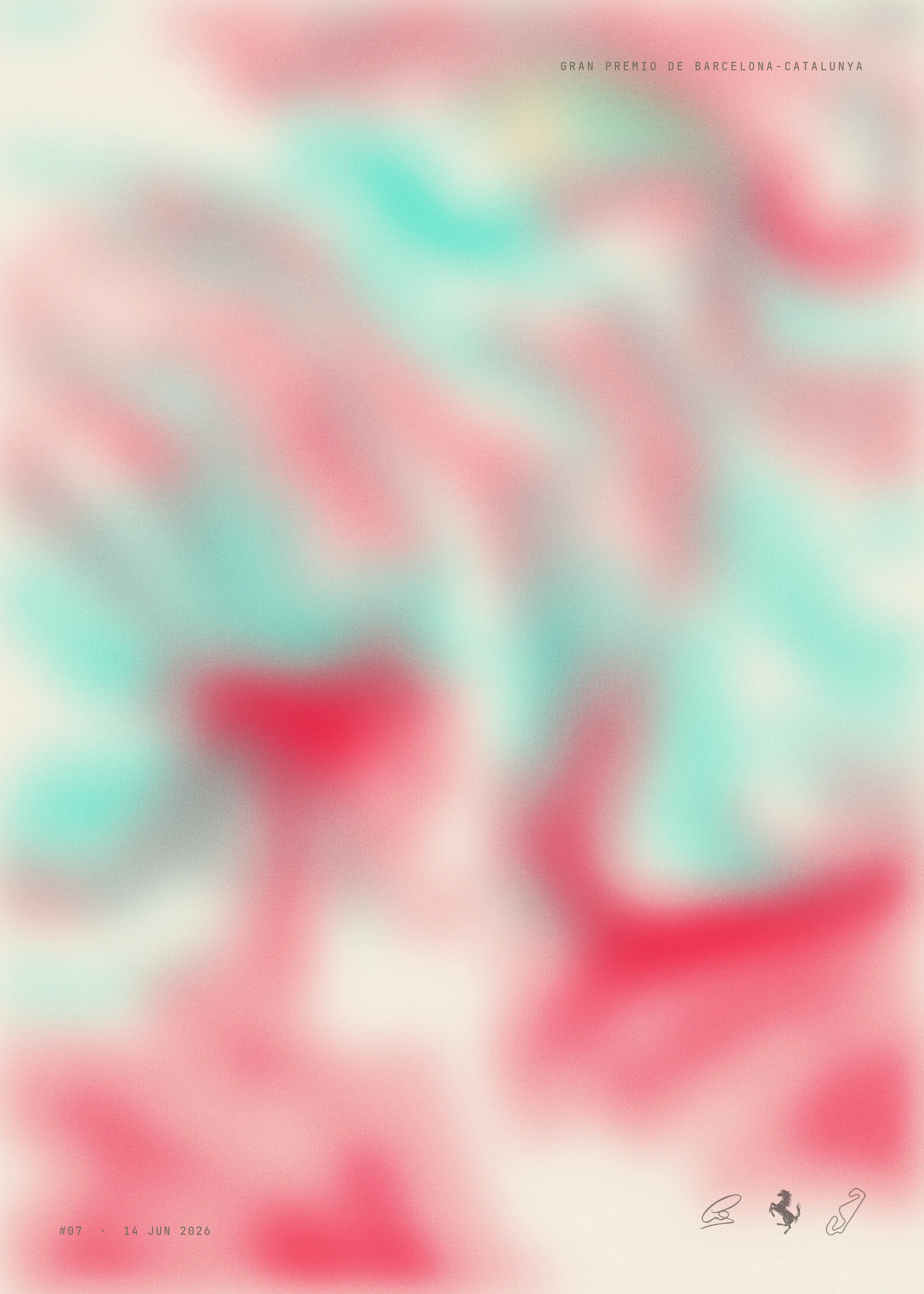
Every poster is generated from one race's real data: the laps, who led each, the gap to second, the moment the win was sealed. Nothing is decorative. Scroll to watch a single Grand Prix (Barcelona, round 07) assemble itself, one rule at a time.
How the poster is built, layer by layer
- 01
Grid
A hidden lattice: one cell per lap.
The canvas is divided into an invisible grid, filled left to right, top to bottom. Barcelona's 66 laps tile into a 9 × 8 lattice that is never printed; it only decides where each lap is seeded.
- 02
Events
Every cell remembers who led that lap.
The lead changed hands 5 times across 4 drivers, until lap 39, where HAMILTON took the lead and never gave it back. Every change, and that decisive lap, leaves its trace in the current that follows.
- 03
Brush
The leader paints; the chaser answers.
Each lap leaves a brushmark in the leader's team colour, the car behind answering in theirs. The bigger the gap to second, the heavier the mark: a near-25-second lead lands thick and certain, while a wheel-to-wheel lap presses two colours together.
- 04
Flow
One current carries every mark.
The brushmarks are released into a single field that drifts across the whole canvas, drawing each one into long parallel bands. Where the lead changed hands, the field twists into a small eddy. The current is seeded by the race ID, so re-rendering the poster returns it identical, down to the pixel.
- 05
Well
The current bends toward one point.
That field is pulled toward lap 39 — the gravity well, the moment the race was settled. Nothing draws it on the finished print; you read it in the way the bands lean inward.
- 06
Smoke
Flat data, made to read as print.
The bands blur into airbrushed smoke, multiplied and dusted with film grain. The frame is set: the title, the round and date, the winner’s signature, team badge and the circuit’s outline. The poster is done.
That is the whole encoding: a hidden grid of laps, two team colours fighting for the lead, a seeded current bending toward the lap the race was won. Look at any poster in the index now and it decodes the same way.
See the Barcelona race →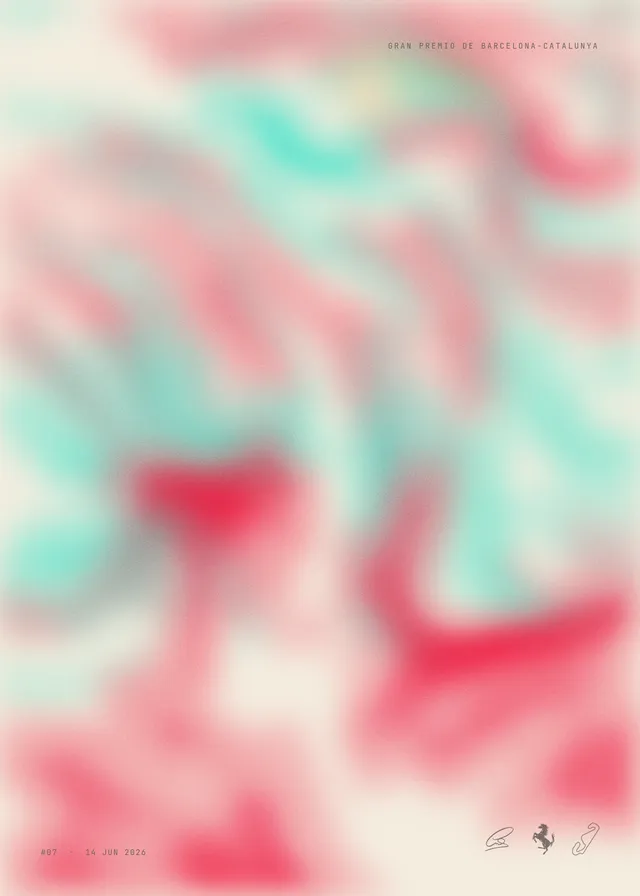 HAMILTON Ferrari
 Classification, gaps, lap timing, overtakes and 2026 livery colours come from OpenF1 and Jolpica-F1, both free and open. Driver of the Day is an editorial vote from Formula 1, recorded per race by hand. Everything is baked to a static snapshot at build time: reproducible, fast, deterministic.
← Back to the index